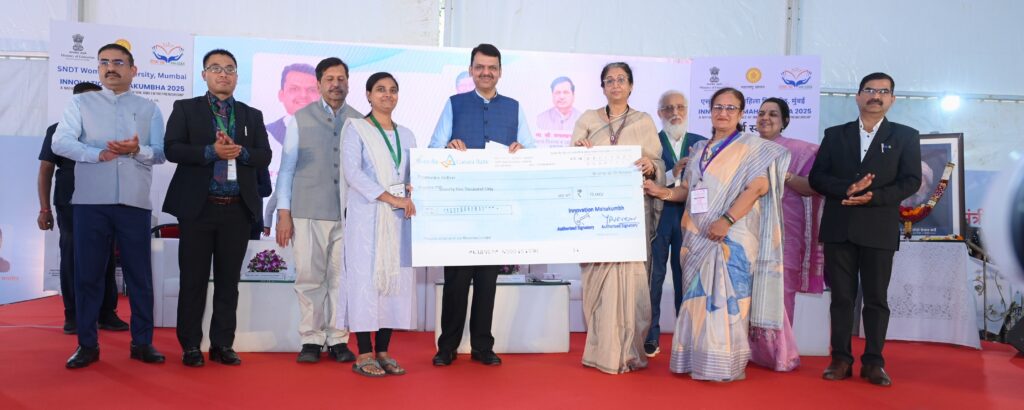
Dr. Monika has earned prestigious recognition by securing 1st Prize at Innovation Mahakumbh 2025, awarded by Devendra Fadnavis, for her groundbreaking innovation in a herbal formulation aimed at combating Tuberculosis.
This remarkable achievement highlights her pioneering contribution to healthcare innovation and reinforces her commitment to advancing natural, effective solutions for one of the world’s most persistent health challenges.
The problem nobody named
For the last decade, Indian women serious about their skin have had exactly two choices.
The first: Ayurveda. Rich in heritage, rooted in India’s extraordinary botanical tradition, genuinely beloved and for most modern skin concerns, frustratingly slow to produce results, often inconsistent in formulation quality, and priced at a premium that puts it out of reach for most.
The second: Modern synthetic skincare. Fast-acting, clinically aggressive, widely available and carrying a growing body of documented concern. Parabens found in the majority of commercial serums and moisturisers are now linked to endocrine disruption and studied for their association with hormonal imbalance. Synthetic preservatives are being restricted or banned by European regulatory authorities that evaluate cosmetic safety more stringently than most markets. Phthalates, found in synthetic fragrances, are among the most widely documented hormone disruptors in daily consumer products. The word “fragrance” on an Indian skincare label can legally represent over a hundred undisclosed synthetic chemicals, none of which need individual declaration.
Most of the ingredients are safe, but their sources makes it, how good they are for your long term use. E.g. Sources of vitamin C, hyloronic acid, kojic acid, alpha arbutin, glycolic acis, cyramids, sylicylic acis, niacinamide.
The Indian woman using a well-marketed synthetic brightening serum every morning may be addressing her hyperpigmentation. She may also be absorbing a daily dose of compounds that were never designed with long-term skin health in mind.
Neither of these two choices was built for her.
What we built instead
iPlus was built by Dr. Monika a pharmaceutical scientist with deep expertise in herbal formulation, analytical chemistry, and the specific biology of Indian skin.
She spent years in pharmaceutical research studying why botanical ingredients fail in cosmetic formulations. Not because the plants are wrong, India’s botanical heritage is among the most clinically validated in the world. But because the cosmetics industry applies those plants at concentrations designed to justify a label claim, not to produce a biological effect.
Amla at 0.2% does not produce the antioxidant and tyrosinase-inhibiting (reduces melanin production) effect documented in the published literature. It produces a product that says “with Amla extract.”
Licorice Root at trace levels does not produce Glabridin’s dual anti-inflammatory and melanin-inhibiting mechanism. It produces a product that photographs well next to the word “botanical.”
What changes this is not synthetic chemistry. It is pharmaceutical discipline applied to botanical actives: standardised extraction, verified concentrations, formulation architecture designed to deliver the active compound to the layer of skin where it does its work.
This is the science Dr. Monika applied to every compound in our formulas.
The iPlus standard
Every ingredient in every iPlus product must satisfy three conditions before it appears in a formula:
A published evidence base specific to Indian skin’s concerns. Not general antioxidant activity. Not in-vitro cell studies. Evidence that the compound addresses hyperpigmentation, post-inflammatory darkening, barrier compromise, or UV-oxidative damage in skin types and UV conditions that reflect the reality of Indian skin in Indian cities.
A standardised active concentration. We declare the standardisation on the label. Amla at 40%+ tannin content. Licorice Root at 2% Glabridin. Bakuchiol at 0.5%. Every active compound present at the concentration where the published research shows clinical significance not at the concentration that meets the minimum threshold for label inclusion.
Validated safety on Indian skin before commercial release. Not theoretical safety. Not a certificate from a contract manufacturer. A real tester cohort, real Indian women with real pigmentation concerns using the formula for the duration required to produce clinical evidence. Tested in Indian summer conditions: 40°C, 75% humidity. Every adverse event reported and reviewed by Dr. Monika personally.
| This is not how the skincare industry works. It is how the pharmaceutical industry works. It is the only standard that produces a formula worth putting on your skin every day. |
Why botanical, and why not Ayurveda
We want to be precise about something that matters:
iPlus is not an Ayurvedic brand.
Ayurveda is a complete medical philosophy a system of diagnosis, treatment, and lifestyle that extends far beyond cosmetic application. To describe a skincare serum as “Ayurvedic” is either a misuse of the tradition or a marketing shorthand that obscures more than it explains.
What iPlus does is different. We take India’s botanical heritage ingredients that traditional Indian medicine identified, used, and refined across thousands of years of empirical observation and formulate them using modern pharmaceutical science.
E.g. Amla’s three thousand year history in Indian skin care is not folklore. It is the empirical record of a compound we now understand as one of the most stable and potent natural antioxidant complexes in botanical dermatology. The traditional practitioners who applied it to skin observed an outcome that modern science has now characterised at the molecular level.
We honour that observation. We do not present it as the product.
The product is what happens when that observation meets pharmaceutical formulation discipline – standardised extraction, verified stability, clinically meaningful concentration, and a delivery system that gets the active where it needs to go.
| India’s plants were always capable of this. They just needed to be formulated properly. |
Why Botanical and not Synthetic Ingredients
Gentle Multi-Action: Unlike synthetic actives that often focus on a single mechanism, these extracts combine pigment inhibition with anti-inflammatory and barrier-repairing properties, which is crucial for preventing “rebound” PIH in melanin-rich skin.
Reduced Irritation Risk: Many synthetic acids can cause stinging or “purging” that may accidentally trigger new inflammation. Botanical alternatives are generally more soothing and suitable for long-term daily use without thinning the skin.

Our founder, Dr. Monika, spent years in pharmaceutical research, specializing in herbal formulations and analytical chemistry. In that time, she developed the ability to look at a skincare product’s ingredient list and measure with scientific instruments, not intuition whether it would actually do what it claimed.
What she measured across the industry was a systematic pattern of underdelivery. Celebrated herbal actives at decorative concentrations. Vitamin C derivatives with poor skin penetration. Brightening ingredients at a fraction of the dose needed for clinical effect. Products that listed the right ingredients and produced the wrong results.
She built iPlus to do the opposite.
Our Values
- Botanical Heritage with Pharmacutical Precision.
- Honest Concentrations, but skin first.
- Fair Value and Full Transparency.